Monday, November 30, 2009

CDC H1N1 Flu Website Situation Update, November 30, 2009

You are subscribed to updates from the Centers for Disease Control and Prevention (CDC).

CDC H1N1 Flu Website Situation Update, November 30, 2009

Key Flu Indicators

Each week CDC analyzes information about influenza disease activity in the United States and publishes findings of key flu indicators in a report called FluView. During the week of November 15-21, 2009, influenza activity decreased in some key indicators and increased in others. Overall influenza activity remains high for this time of year. Below is a summary of the most recent key indicators:

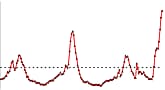
  • Visits to doctors for influenza-like illness (ILI) nationally decreased sharply this week over last week with all regions showing declines in ILI. This is the fourth consecutive week of national decreases in ILI after four consecutive weeks of sharp increases While ILI has declined, visits to doctors for influenza-like illness remain high.
  • Influenza hospitalization rates remain higher than expected for this time of year. Hospitalization rates continue to be highest in younger populations with the highest hospitalization rate reported in children 0-4 years old.
  • The proportion of deaths attributed to pneumonia and influenza (P&I) based on the 122 Cities Report continues to be higher than expected for this time of year. This proportion has remained elevated for eight weeks now. In addition, 35 flu-related pediatric deaths were reported this week: 27 of these deaths were associated with laboratory confirmed 2009 H1N1; 7 were influenza A viruses, but were not subtyped and one death was associated with a seasonal influenza A (H1) virus. The one death associated with seasonal influenza A (H1) virus infection reported this week actually occurred in March, during the 2008-09 season. Since April 2009, CDC has received reports of 234 laboratory-confirmed pediatric deaths:  198 due to 2009 H1N1, 35 pediatric deaths that were laboratory confirmed as influenza, but the flu virus subtype was not determined, and one pediatric death associated with a seasonal influenza virus. (Laboratory-confirmed deaths are thought to represent an undercount of the actual number. CDC has provided estimates about the number of 2009 H1N1 cases and related hospitalizations and deaths.)
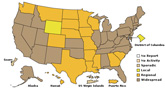
  • Thirty-two states are reporting widespread influenza activity at this time; a decline of 11 states from last week. They are: Alabama, Alaska, Arizona, California, Connecticut, Delaware, Florida, Idaho, Illinois, Indiana, Kansas, Kentucky, Maine, Maryland, Massachusetts, Michigan, Nevada, New Hampshire, New Jersey, New Mexico, New York, North Carolina, Ohio, Oklahoma, Oregon, Pennsylvania, Rhode Island, Tennessee, Utah, Vermont, Virginia, and West Virginia).
  • Almost all of the influenza viruses identified so far continue to be 2009 H1N1 influenza A viruses. These viruses remain similar to the virus chosen for the 2009 H1N1 vaccine, and remain susceptible to the antiviral drugs oseltamivir and zanamivir with rare exception.

*All data are preliminary and may change as more reports are received.

Learn more >> 

U.S. Situation Update

Weekly Flu Activity Estimates

U.S. Patient Visits Reported for Influenza-like Illness (ILI)
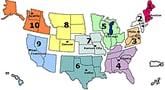
U.S. Influenza-like Illness (ILI) Reported by Regions
U.S. Laboratory Confirmed Influenza-Associated Hospitalizations
and Deaths from August 30 to November 21, 2009

Posted November 30, 2009, 11:00 AM ET
Data reported to CDC by November 24, 2009, 12:00 AM ET
Cases Defined by
Hospitalizations
Deaths
Influenza Laboratory-Tests** 29,348 1,224

*Reports can be based on syndromic, admission or discharge data, or a combination of data elements that could include laboratory-confirmed and influenza-like illness hospitalizations.

*Laboratory confirmation includes any positive influenza test (rapid influenza tests, RT-PCR, DFA, IFA, or culture), whether or not typing was done.

The table shows aggregate reports of all laboratory confirmed influenza hospitalizations and deaths (including 2009 H1N1 and seasonal flu) since August 30, 2009 received by CDC from U.S. states and territories**. This table will be updated weekly each Friday at 11 a.m. For the 2009-2010 influenza season, states are reporting based on new case definitions for hospitalizations and deaths effective August 30, 2009.

CDC will continue to use its traditional surveillance systems to track the progress of the 2009-2010 influenza season. For more information about influenza surveillance, including reporting of influenza-associated hospitalizations and deaths, see Questions and Answers: Monitoring Influenza Activity, Including 2009 H1N1.

The number of 2009 H1N1 hospitalizations and deaths reported to CDC from April – August 2009 is available on the Past Situation Updates page.

For state level information, refer to state health departments.

International Human Cases of 2009 H1N1 Flu Infection
See:
World Health Organization.

**States report weekly to CDC either 1) laboratory-confirmed influenza hospitalizations and deaths or 2) pneumonia and influenza syndrome-based cases of hospitalization and death resulting from all types or subtypes of influenza. Although only the laboratory confirmed cases are included in this report, CDC continues to analyze data both from laboratory confirmed and syndromic hospitalizations and deaths.


U.S. Influenza-associated Pediatric Mortality
Posted November 30, 2009
Data reported to CDC by November 21, 2009
Date Reported
Laboratory-Confirmed 2009 H1N1 Influenza Pediatric Deaths
Laboratory-Confirmed Influenza A Subtype Unknown Pediatric Deaths
Laboratory-Confirmed
Seasonal
Influenza
Total
This Week  (Week 46, November 15-21, 2009) 27 7 1 35
Since August 30, 2009 140 32 0 172
Cumulative since April 26, 2009 198 35 1 234

This table is based on data reported to CDC through the Influenza-Associated Pediatric Mortality Surveillance System. Influenza-associated deaths in children (persons less than 18 years) was added as nationally notifiable condition in 2004.

For more information about influenza-associated pediatric mortality, see FluView.

For more information about the U.S. situation, see the CDC H1N1 Flu U.S. Situation page.

International Situation Update
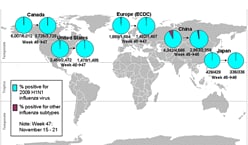
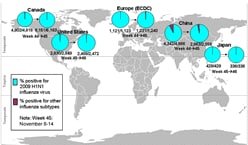
This report provides an update to the international situation as of November 30, 2009. The World Health Organization (WHO) continues to report laboratory-confirmed 2009 H1N1 flu cases and deaths on its Web page. These laboratory-confirmed cases represent a substantial underestimation of total cases in the world, as many countries focus surveillance and laboratory testing only on people with severe illness. The 2009 H1N1 influenza virus continues to be the dominant influenza virus in circulation in the world. From April 19 to November 14, 2009, 70.5% of influenza specimens reported to WHO were 2009 H1N1 viruses and from November 8 to November 14, 2009, 89.4% of influenza specimens reported to WHO were 2009 H1N1. In temperate regions of the Southern Hemisphere, little disease activity due to 2009 H1N1 has been reported. In tropical regions of the Americas and Asia, influenza activity due to 2009 H1N1 remains variable. In temperate regions of the Northern Hemisphere, influenza-like illness (ILI) activity due to 2009 H1N1 remains high across many countries in Europe, Asia, and North America, though it may have peaked in most areas of the United States and in Canada.

For more information about the international situation, see the CDC H1N1 Flu International Situation page.

Recent Updates of Interest

Additional Updates on the CDC H1N1 Flu Website

To learn about other recent updates made to the CDC H1N1 Flu Website, please check the "What's New" page on the CDC H1N1 Flu website.


Get H1N1 Updates & Health Tips via Text Message
For CDC Info, Text 'Health' to 87000. www.flu.govSign up to get health updates sent via text message. Messages are sent about three times a week with relevant H1N1 flu updates and timely health tips.

Text UPDATES to 87000 to sign up.

To learn more, see www.cdc.gov/mobile.


Modify/Update Subscriber Preferences  |  Unsubscribe  |  Send Feedback  |  Learn more about CDC Email Updates
 
To receive the latest news for your region, please update your profile with your country, state and zip code.
 
Questions or problems?  Please contact support@govdelivery.com.

Department of Health and Human Services

Fight Flu with Facts! • Visit Flu.gov
Call 800-232-4636 • Text UPDATES to 87000

Centers for Disease Control and Prevention

Centers for Disease Control and Prevention (CDC) · 1600 Clifton Rd · Atlanta GA 30333 · 800-CDC-INFO (800-232-4636)

Wednesday, November 25, 2009

CDC H1N1 Flu Website Situation Update, November 25, 2009

You are subscribed to updates from the Centers for Disease Control and Prevention (CDC).

CDC H1N1 Flu Website Situation Update, November 25, 2009

NOTE: Due to the Thanksgiving holiday, the regular Situation Update numbers will be reported on the website on the following Monday (December 1) instead of on Friday, November 27. Modified email updates are therefore being sent today and on Monday, November 27.

2009 H1N1 Influenza Vaccine Supply Status

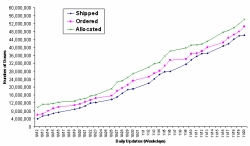
2009 Vaccine Doses Distributed, Ordered, and AllocatedAs of November 24, a total of 51,798,420 doses of H1N1 flu vaccine have been shipped throughout the United States. (NOTE: this daily report is now available in XML format to make it easier for states and other partners to use the data for their own purposes.)

View the latest Vaccine Supply Report >>

CDC Experts Contributing to WebMD's Focus on Flu Blog

Follow CDC Experts on WebMDs Flu Blog – Visit NowIn collaboration with WebMD, experts from the Centers for Disease Control and Prevention are guest blogging and helping to answer questions on WebMD's Focus on Flu Blog. Check out two recent CDC blog posts by Anthony Fiore, MD, MPH, medical epidemiologist with the CDC's Influenza Division -- "Using Antivirals to Treat H1N1 Swine Flu"  and "2009 H1N1 Influenza Vaccine Safety" -- and this week's post, "Healthy Travels During Flu Season" by CDC guest blogger, Gary W. Brunette, MD, MS, medical epidemiologist for the CDC's Travelers' Health Branch. The Focus on Flu blog is scheduled to run through the end of December.

Fraudulent 2009 H1N1 Influenza Products

Screen scot of the Fraudulent H1N1 Products WidgetCheck FDA’s list of fraudulent H1N1 flu products that aren’t approved for diagnosis, prevention, or treatment: www.fda.gov/h1n1fraud.

OR

Place the Fraudulent H1N1 Products Widget on your Web site, portal home page, or in your blog to allow you and your visitors to search for Fraudulent H1N1 Products. Learn more >>

Recent Updates of Interest

Additional Updates on the CDC H1N1 Flu Website

To learn about other recent updates made to the CDC H1N1 Flu Website, please check the "What's New" page on the CDC H1N1 Flu website.


Get H1N1 Updates & Health Tips via Text Message

For CDC Info, Text 'Health' to 87000. www.flu.govSign up to get health updates sent via text message. Messages are sent about three times a week with relevant H1N1 flu updates and timely health tips.

Text UPDATES to 87000 to sign up.

To learn more, see www.cdc.gov/mobile.


Modify/Update Subscriber Preferences  |  Unsubscribe  |  Send Feedback  |  Learn more about CDC Email Updates
 
To receive the latest news for your region, please update your profile with your country, state and zip code.
 
Questions or problems?  Please contact support@govdelivery.com.

Department of Health and Human Services

Fight Flu with Facts! • Visit Flu.gov
Call 800-232-4636 • Text UPDATES to 87000

Centers for Disease Control and Prevention

Centers for Disease Control and Prevention (CDC) · 1600 Clifton Rd · Atlanta GA 30333 · 800-CDC-INFO (800-232-4636)

Friday, November 20, 2009

CDC H1N1 Flu Website Situation Update, November 20, 2009

You are subscribed to updates from the Centers for Disease Control and Prevention (CDC).

Key Flu Indicators

Each week CDC analyzes information about influenza disease activity in the United States and publishes findings of key flu indicators in a report called FluView.* During the week of November 8-14, 2009, influenza activity decreased across all key indicators, but overall remained very high for this time of year. Below is a summary of the most recent key indicators:

  • Visits to doctors for influenza-like illness (ILI) nationally decreased again this week over last week. This is the third consecutive week of national decreases in ILI after four consecutive weeks of sharp increases. (All regions showed declines in ILI.) While ILI declined overall nationally, visits to doctors for influenza-like illness remain high.
  • Influenza hospitalization rates are beginning to decline but remain higher than expected for this time of year. Hospitalization rates continue to be highest in younger populations with the highest hospitalization rate reported in children 0-4 years old.
  • The proportion of deaths attributed to pneumonia and influenza (P&I) based on the 122 Cities Report decreased slightly but is still higher than what is expected for this time of year and has remained elevated for seven weeks now. In addition, 21 flu-related pediatric deaths were reported this week: 15 of these deaths were associated with laboratory confirmed 2009 H1N1; 6 were influenza A viruses, but were not subtyped. Since April 2009, CDC has received reports of 171 laboratory-confirmed pediatric 2009 H1N1 deaths, one influenza B death, and another 28 pediatric deaths that were laboratory confirmed as influenza, but the flu virus subtype was not determined. (Laboratory-confirmed deaths are thought to represent an undercount of the actual number. CDC has provided estimates about the number of 2009 H1N1 cases and related hospitalizations and deaths.
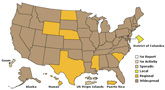
  • Forty-three states are reporting widespread influenza activity at this time; a decline of three states from last week. They are: Alabama, Alaska, Arizona, Arkansas, California, Colorado, Connecticut, Delaware, Florida, Georgia, Idaho, Illinois, Indiana, Iowa, Kansas, Kentucky, Louisiana, Maine, Maryland, Massachusetts, Michigan, Minnesota, Missouri, Montana, Nevada, New Hampshire, New Jersey, New Mexico, New York, North Carolina, Ohio, Oklahoma, Oregon, Pennsylvania, Rhode Island, South Dakota, Tennessee, Utah, Vermont, Virginia, Washington, West Virginia, and Wisconsin.
  • Almost all of the influenza viruses identified so far continue to be 2009 H1N1 influenza A viruses. These viruses remain similar to the virus chosen for the 2009 H1N1 vaccine, and remain susceptible to the antiviral drugs oseltamivir and zanamivir with rare exception.

*All data are preliminary and may change as more reports are received.

Learn more >> 

U.S. Situation Update

Weekly Flu Activity Estimates

U.S. Patient Visits Reported for Influenza-like Illness (ILI)

U.S. Influenza-like Illness (ILI) Reported by Regions

U.S. Laboratory Confirmed Influenza-Associated Hospitalizations
and Deaths from August 30 to November 14, 2009

Posted November 20, 2009, 11:00 AM ET
Data reported to CDC by November 17, 2009, 12:00 AM ET
Cases Defined by
Hospitalizations
Deaths
Influenza Laboratory-Tests** 26,315 1,049

*Reports can be based on syndromic, admission or discharge data, or a combination of data elements that could include laboratory-confirmed and influenza-like illness hospitalizations.

*Laboratory confirmation includes any positive influenza test (rapid influenza tests, RT-PCR, DFA, IFA, or culture), whether or not typing was done.

The table shows aggregate reports of all laboratory confirmed influenza hospitalizations and deaths (including 2009 H1N1 and seasonal flu) since August 30, 2009 received by CDC from U.S. states and territories**. This table will be updated weekly each Friday at 11 a.m. For the 2009-2010 influenza season, states are reporting based on new case definitions for hospitalizations and deaths effective August 30, 2009.

CDC will continue to use its traditional surveillance systems to track the progress of the 2009-2010 influenza season. For more information about influenza surveillance, including reporting of influenza-associated hospitalizations and deaths, see Questions and Answers: Monitoring Influenza Activity, Including 2009 H1N1.

The number of 2009 H1N1 hospitalizations and deaths reported to CDC from April – August 2009 is available on the Past Situation Updates page.

For state level information, refer to state health departments.

International Human Cases of 2009 H1N1 Flu Infection
See:
World Health Organization.

**States report weekly to CDC either 1) laboratory-confirmed influenza hospitalizations and deaths or 2) pneumonia and influenza syndrome-based cases of hospitalization and death resulting from all types or subtypes of influenza. Although only the laboratory confirmed cases are included in this report, CDC continues to analyze data both from laboratory confirmed and syndromic hospitalizations and deaths.


U.S. Influenza-associated Pediatric Mortality
Posted November 20, 2009 (Updated each Friday)
Data reported to CDC by November 14, 2009
Date Reported
Laboratory-Confirmed 2009 H1N1 Influenza Pediatric Deaths
Laboratory-Confirmed Influenza A Subtype Unknown Pediatric Deaths
Laboratory-Confirmed
Seasonal
Influenza
Total
This Week  (Week 45, November 8-14, 2009) 15 6 0 21
Since August 30, 2009 113 25 0 138
Cumulative since April 26, 2009 171 28 1 200

This table is based on data reported to CDC through the Influenza-Associated Pediatric Mortality Surveillance System. Influenza-associated deaths in children (persons less than 18 years) was added as nationally notifiable condition in 2004.

For more information about influenza-associated pediatric mortality, see FluView.

For more information about the U.S. situation, see the CDC H1N1 Flu U.S. Situation page.

International Situation Update

This report provides an update to the international situation as of November 20, 2009. The World Health Organization (WHO) continues to report laboratory-confirmed 2009 H1N1 flu cases and deaths on its Web page. These laboratory-confirmed cases represent a substantial underestimation of total cases in the world, as many countries focus surveillance and laboratory testing only on people with severe illness. The 2009 H1N1 influenza virus continues to be the dominant influenza virus in circulation in the world. From April 19 to October 31, 2009, 68.8% of influenza specimens reported to WHO were 2009 H1N1 viruses and from November 1 to November 7, 2009, 79.1% of influenza specimens reported to WHO were 2009 H1N1. In temperate regions of the Southern Hemisphere, little disease activity due to 2009 H1N1 has been reported. In tropical regions of the Americas and Asia, influenza activity due to 2009 H1N1 remains variable. In temperate regions of the Northern Hemisphere, influenza-like illness (ILI) activity due to 2009 H1N1 continues to increase across many countries in Europe, Asia, and North America, though it may have peaked in most areas of the United States.

For more information about the international situation, see the CDC H1N1 Flu International Situation page.

2009 H1N1 Influenza Vaccine in Pregnancy

Watch CDC Expert Video CommentariesPregnant women are 1 of the 5 initial target groups for the 2009 H1N1 influenza vaccine. In this video commentary, Sonja Rasmussen, MD, MS, Senior Scientist at CDC, reviews the latest guidelines. Watch now >>

Recent Updates of Interest

  • 2009 H1N1 Flu: International Situation Update
    This report provides an update to the international situation as of November 20, 2009. The World Health Organization (WHO) continues to report updated 2009 H1N1 flu-associated laboratory-confirmed cases and deaths on its Web page.
  • Weekly FluView Map and Surveillance Report for Week Ending November 14, 2009
    During the week of November 8-14, 2009, influenza activity decreased slightly in the United States as reported in FluView. Flu activity is widespread in 43 states. Nationally, visits to doctors for influenza-like-illness declined from last week, but are still higher than expected for this time of year. Flu-related hospitalizations and deaths have declined slightly, but are still very high nation-wide compared to what is expected for this time of year.
  • Weekly FluView Map and Surveillance Report for Week Ending November 14, 2009
    During the week of November 8-14, 2009, influenza activity decreased slightly in the United States as reported in FluView. Flu activity is widespread in 43 states. Nationally, visits to doctors for influenza-like-illness declined from last week, but are still higher than expected for this time of year. Flu-related hospitalizations and deaths have declined slightly, but are still very high nation-wide compared to what is expected for this time of year.
  • NEW: Information for Vaccine Planners - Supply and Distribution
    These tables for healthcare providers and planners provide information related to spacing between the two doses of 2009 H1N1 Vaccine for children 6 months through 9 years of age and for administration of 2009 H1N1 Vaccine with seasonal influenza and other vaccines.
  • New: Graphical Representations of a Generic Influenza Virus
    These pictures provide a 3D graphical representation of the biology and structure of a generic influenza virus, and are not specific to the 2009 H1N1 virus.
  • U.S. Influenza and Pneumonia-Associated Hospitalizations and Deaths from August 30 to November 14, 2009
    During the week of November 8-14, 2009, influenza activity decreased slightly in the United States as reported in FluView. Flu activity is widespread in 43 states. Nationally, visits to doctors for influenza-like-illness declined from last week, but are still higher than expected for this time of year. Flu-related hospitalizations and deaths have declined slightly, but are still very high nation-wide compared to what is expected for this time of year.
  • New: Updated Guidance for the Use of CSL 2009 H1N1 Monovalent Vaccine
    On November 11, 2009, the FDA expanded the approved use of CSL's seasonal and 2009 H1N1 monovalent influenza vaccines to include children aged 6 months and older. Both vaccines had previously been approved only for use in adults, aged 18 years and older.
  • New: Questions and Answers: 2009 H1N1 and Pneumococcal Disease in the News
    What is invasive pneumococcal disease? What does CDC know about invasive pneumococcal disease among people who get 2009 H1N1 or seasonal influenza? What is Active Bacterial Core surveillance (ABCs)?
  • New: 2009 H1N1 Flu Information for People with Disabilities and Their Caregivers or Personal Assistants
    People with certain types of disability have a higher risk of getting flu-related complications, such as pneumonia. The 2009 H1N1 Flu Information for People with Disabilities and Their Caregivers or Personal Assistants is now available to the public.

Additional Updates on the CDC H1N1 Flu Website

To learn about other recent updates made to the CDC H1N1 Flu Website, please check the "What's New" page on the CDC H1N1 Flu website.

Get H1N1 Updates & Health Tips via Text Message

For CDC Info, Text 'Health' to 87000. www.flu.govSign up to get health updates sent via text message. Messages are sent about three times a week with relevant H1N1 flu updates and timely health tips.

Text UPDATES to 87000 to sign up.

To learn more, see www.cdc.gov/mobile.


Modify/Update Subscriber Preferences  |  Unsubscribe  |  Send Feedback  |  Learn more about CDC Email Updates
 
To receive the latest news for your region, please update your profile with your country, state and zip code.
 
Questions or problems?  Please contact support@govdelivery.com.

Department of Health and Human Services

Fight Flu with Facts! • Visit Flu.gov
Call 800-232-4636 • Text UPDATES to 87000

Centers for Disease Control and Prevention

Centers for Disease Control and Prevention (CDC) · 1600 Clifton Rd · Atlanta GA 30333 · 800-CDC-INFO (800-232-4636)

Friday, November 13, 2009

CDC H1N1 Flu Website Situation Update, November 13, 2009

You are subscribed to updates from the Centers for Disease Control and Prevention (CDC).

Key Flu Indicators

Each week CDC analyzes information about influenza disease activity in the United States and publishes findings of key flu indicators in a report called FluView.* During the week of November 1-7, 2009, a review of key indicators found that certain indicators declined, while others continued to rise. Overall, flu activity in the United Sates remained very high. Below is a summary of the most recent key indicators:

  • Visits to doctors for influenza-like illness (ILI) nationally decreased this week over last week. This is the second week of national decreases in ILI after four consecutive weeks of sharp increases. (All regions but one showed declines in ILI. Region I (CT, ME, MA, NH, RI and VT) continues to show sharp increases in ILI activity. While ILI declined overall nationally, visits to doctors for influenza-like illness remain higher than what is seen during the peak of many regular flu seasons.
  • Total influenza hospitalization rates for laboratory-confirmed flu continue to climb and remain higher than expected for this time of year. Hospitalization rates continue to be highest in younger populations with the highest hospitalization rate reported in children 0-4 years old.
  • The proportion of deaths attributed to pneumonia and influenza (P&I) based on the 122 Cities Report continues to increase and has been higher than what is expected for six weeks now. In addition, 35 flu-related pediatric deaths were reported this week: 26 of these deaths were associated with laboratory confirmed 2009 H1N1; eight were influenza A viruses, but were not subtyped; and one was an influenza B virus. Since April 2009, CDC has received reports of 156 laboratory-confirmed pediatric 2009 H1N1 deaths, one influenza B death, and another 23 pediatric deaths that were laboratory confirmed as influenza, but the flu virus subtype was not determined.
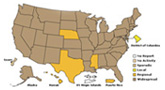
  • Forty-six states are reporting widespread influenza activity at this time; a decline of two states over last week. They are: Alabama, Alaska, Arizona, Arkansas, California, Colorado, Connecticut, Delaware, Florida, Georgia, Idaho, Illinois, Indiana, Iowa, Kansas, Kentucky, Louisiana, Maine, Maryland, Massachusetts, Michigan, Minnesota, Missouri, Montana, Nevada, New Hampshire, New Jersey, New Mexico, New York, North Carolina, North Dakota, Ohio, Oklahoma, Oregon, Pennsylvania, Rhode Island, South Carolina, South Dakota, Tennessee, Utah, Vermont, Virginia, Washington, West Virginia, Wisconsin, and Wyoming. This many reports of widespread activity at this time of year are unprecedented during seasonal flu.
  • Almost all of the influenza viruses identified so far continue to be 2009 H1N1 influenza A viruses. These viruses remain similar to the virus chosen for the 2009 H1N1 vaccine, and remain susceptible to the antiviral drugs oseltamivir and zanamivir with rare exception

*All data are preliminary and may change as more reports are received.

Learn more >> 

U.S. Situation Update

Weekly Flu Activity Estimates

U.S. Patient Visits Reported for Influenza-like Illness (ILI)

U.S. Influenza-like Illness (ILI) Reported by Regions

U.S. Laboratory Confirmed Influenza-Associated Hospitalizations
and Deaths from August 30 to November 7, 2009

Posted November 13, 2009, 11:00 AM ET
Data reported to CDC by November 10, 2009, 12:00 AM ET
Cases Defined by
Hospitalizations
Deaths
Influenza Laboratory-Tests** 22,364 877

*Reports can be based on syndromic, admission or discharge data, or a combination of data elements that could include laboratory-confirmed and influenza-like illness hospitalizations.

*Laboratory confirmation includes any positive influenza test (rapid influenza tests, RT-PCR, DFA, IFA, or culture), whether or not typing was done.

The table shows aggregate reports of all laboratory confirmed influenza hospitalizations and deaths (including 2009 H1N1 and seasonal flu) since August 30, 2009 received by CDC from U.S. states and territories**. This table will be updated weekly each Friday at 11 a.m. For the 2009-2010 influenza season, states are reporting based on new case definitions for hospitalizations and deaths effective August 30, 2009.

CDC will continue to use its traditional surveillance systems to track the progress of the 2009-2010 influenza season. For more information about influenza surveillance, including reporting of influenza-associated hospitalizations and deaths, see Questions and Answers: Monitoring Influenza Activity, Including 2009 H1N1.

The number of 2009 H1N1 hospitalizations and deaths reported to CDC from April – August 2009 is available on the Past Situation Updates page.

For state level information, refer to state health departments.

International Human Cases of 2009 H1N1 Flu Infection
See:
World Health Organization External Web Site Icon.

**States report weekly to CDC either 1) laboratory-confirmed influenza hospitalizations and deaths or 2) pneumonia and influenza syndrome-based cases of hospitalization and death resulting from all types or subtypes of influenza. Although only the laboratory confirmed cases are included in this report, CDC continues to analyze data both from laboratory confirmed and syndromic hospitalizations and deaths.

U.S. Influenza-associated Pediatric Mortality
Posted November 13, 2009 (Updated each Friday)
Data reported to CDC by November 7, 2009
Date Reported
Laboratory-Confirmed 2009 H1N1 Influenza Pediatric Deaths
Laboratory-Confirmed Influenza A Subtype Unknown Pediatric Deaths
Laboratory-Confirmed
Seasonal
Influenza
Total
This Week  (Week 44, November 1-7, 2009) 26 8 1 35
Since August 30, 2009 98 19 0 117
Cumulative since April 26, 2009 156 22 1 179

This table is based on data reported to CDC through the Influenza-Associated Pediatric Mortality Surveillance System. Influenza-associated deaths in children (persons less than 18 years) was added as nationally notifiable condition in 2004.

For more information about influenza-associated pediatric mortality, see FluView.

For more information about the U.S. situation, see the CDC H1N1 Flu U.S. Situation page.

International Situation Update

This report provides an update to the international situation as of November 13, 2009. The World Health Organization (WHO) continues to report laboratory-confirmed 2009 H1N1 flu cases and deaths on its Web page. These laboratory-confirmed cases represent a substantial underestimation of total cases in the world, as many countries focus surveillance and laboratory testing only on people with severe illness. The 2009 H1N1 influenza virus continues to be the dominant influenza virus in circulation in the world. Since April 19, 2009, more than 65% of all influenza positive specimens reported to WHO have been 2009 H1N1. In temperate regions of the Southern Hemisphere, little disease activity due to 2009 H1N1 has been reported. In tropical regions of the Americas and Asia, influenza activity due to 2009 H1N1 remains variable. In temperate regions of the Northern Hemisphere, influenza-like illness (ILI) activity due to 2009 H1N1 continues to increase across many countries in Europe and Asia, as well as many areas of the United States, Mexico and Canada.

For more information about the international situation, see the CDC H1N1 Flu International Situation page.

CDC Releases New Widget:  5 in 5: Clinician Quick Facts for 2009 H1N1

Screen shot of new 5 in 5 Clinician Quick Facts for 2009 H1N1 widgetCDC released a new widget this week for clinicians. The "5 in 5: Clinician Quick Facts for 2009 H1N1" widget provides five quick facts for health care providers and clinicians to consider when evaluating a patient for antiviral treatment. This and other CDC widgets are available at http://www.cdc.gov/widgets.

CDC Releases New Video: H1N1 Flu Vaccine – Why the Delay?

Screen shot of Video: H1N1 Flu Vaccine -- Why the Delay?Flu vaccine is the single best way to protect against influenza illness. Watch a short video to understand how flu vaccines are made, why manufacturing and shipping vaccine take so long, and how you can find flu vaccines near you.

You can learn more about flu vaccines at www.cdc.gov/h1n1flu or www.cdc.gov/flu.

To view and download links for other CDC videos, visit CDC-TV www.cdc.gov/CDCTV or CDC's YouTube channel www.youtube.com/cdcstreaminghealth. 

Recent Updates of Interest

Additional Updates on the CDC H1N1 Flu Website

To learn about other recent updates made to the CDC H1N1 Flu Website, please check the "What's New" page on the CDC H1N1 Flu website.


Modify/Update Subscriber Preferences  |  Unsubscribe  |  Send Feedback  |  Learn more about CDC Email Updates
 
To receive the latest news for your region, please update your profile with your country, state and zip code.
 
Questions or problems?  Please contact support@govdelivery.com.

Department of Health and Human Services

Fight Flu with Facts! • Visit Flu.gov
Call 800-232-4636 • Text UPDATES to 87000

Centers for Disease Control and Prevention

Centers for Disease Control and Prevention (CDC) · 1600 Clifton Rd · Atlanta GA 30333 · 800-CDC-INFO (800-232-4636)