You are subscribed to updates from the Centers for Disease Control and Prevention (CDC).
Key Flu Indicators
Each week CDC analyzes information about influenza disease activity in the United States and publishes findings of key flu indicators in a report called FluView. During the week of August 16-22, 2009, a review of these key indictors found that influenza activity is either stable, or is increasing in some areas. Activity appears to be increasing in the Southeast based on influenza-like illness data reported by health care providers. Below is a summary of the most recent key indicators:
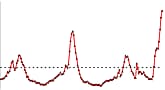
- Visits to doctors for influenza-like illness (ILI) were highest in February during the 2008-09 flu season, but rose again in April 2009 after the new H1N1 virus emerged. Current visits to doctors for influenza-like illness are down from April, but are higher than what is expected in the summer and has increased over the last two weeks.
- Total influenza hospitalization rates for adults and children are similar to or lower than seasonal influenza hospitalization rates depending on age group.
- The proportion of deaths attributed to pneumonia and influenza (P&I) was low and within the bounds of what is expected in the summer.
- Most state health officials are reporting regional or sporadic influenza activity. Two states (Alaska and Georgia) and Puerto Rico are reporting widespread influenza activity at this time. Any reports of widespread influenza activity in August are very unusual.
- Almost all of the influenza viruses identified were the new 2009 H1N1 influenza A viruses. These 2009 H1N1 viruses remain similar to the viruses chosen for the 2009 H1N1 vaccine and remain susceptible to antiviral drugs (oseltamivir and zanamivir) with rare exception.
U.S. Situation Update

U.S. Patient Visits Reported for Influenza-like Illness (ILI)
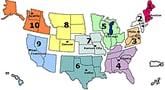
U.S. Influenza-like Illness (ILI) Reported by Regions
| Reporting States and Territories* | Hospitalized Cases | Deaths | |
|---|---|---|---|
| 52 states and territories | 8,843 hospitalized cases | 556 deaths | |
| *Includes the District of Columbia, American Samoa, Guam, Puerto Rico and the U.S. Virgin Islands. The number of hospitalized novel H1N1 cases and deaths presented in this table are an aggregate of reports received by CDC from U.S. states and territories and will be updated weekly each Friday at 11am. For state level information, refer to state health departments. CDC discontinued reporting of individual confirmed and probable cases of novel H1N1 infection on July 24, 2009. CDC will report the total number of hospitalizations and deaths weekly, and continue to use its traditional surveillance systems to track the progress of the novel H1N1 flu outbreak. International Human Cases of H1N1 Flu Infection | |||
For more information about the U.S. situation, see the CDC H1N1 Flu website.
International Situation Update
 This situation report provides an update to the international situation as of August 28, 2009. As of August 23, the World Health Organization (WHO) regions have reported over 209,438 laboratory-confirmed cases of 2009 H1N1 influenza virus (2009 H1N1) with at least 2,185 deaths. The laboratory-confirmed cases represent an underestimation of total cases in the world as many countries now focus surveillance and laboratory testing only in persons with severe illness. The 2009 H1N1 influenza virus continues to be the dominant influenza virus in circulation in the world. Decreases in disease due to 2009 H1N1 continue to be reported from South America and parts of Australia. The United Kingdom is also reporting national decreases in disease due to 2009 H1N1. In contrast, disease associated with 2009 H1N1 influenza is continuing to increase in southern Africa and more Africa countries have reported their first cases. In addition, 2009 H1N1 continues to circulate in tropical countries.
For more information, see the International Situation Update >>
Recent Updates of Interest
- Weekly FluView Map and Surveillance Report for Week Ending August 22, 2009
During week 32 (August 16-22, 2009), influenza activity remained stable in the United States; however, there were still higher levels of influenza-like illness than is normal for this time of year. - State/Jurisdiction Contact Information for Providers Interested in Providing H1N1 Vaccine
Provides a state-by-state list of names, websites, phone numbers, and email addresses. - Updated: Questions & Answers Novel H1N1 Influenza Vaccine
New question added: Do those that have been previously vaccinated against the 1976 swine influenza need to get vaccinated against the 2009 H1N1 influenza? - 2009 H1N1 Flu: International Situation Update
This situation report provides an update to the international situation as of August 28, 2009. As of August 23, the World Health Organization (WHO) regions have reported over 209,438 laboratory-confirmed cases of 2009 H1N1 influenza virus (2009 H1N1) with at least 2,185 deaths. - 2009 H1N1 Flu: U.S. Situation Update
As of 11:00 AM ET on August 28, 2009, CDC is reporting 8,842 hospitalized cases and 555 deaths in 51 states and territories (including the District of Columbia, American Samoa, Guam, Puerto Rico and the U.S. Virgin Islands). - Topic Areas For CDC H1N1 Public Health Emergency Response Projects
The following information describes areas under active investigation by CDC and public health partners. Data generated by these projects will be used to guide the ongoing response to the H1N1 outbreak. - 2009 Pandemic Influenza A (H1N1) Virus Infections --- Chicago, Illinois, April--July 2009
Morbidity and Mortality Weekly Report (MMWR) August 28, 2009 / 58(33);913-918 - Surveillance for the 2009 Pandemic Influenza A (H1N1) Virus and Seasonal Influenza Viruses --- New Zealand, 2009
Morbidity and Mortality Weekly Report (MMWR) August 28, 2009 / 58(33);918-921 - Community Flu 1.0
CommunityFlu is a software program that simulates the spread of influenza through a model community, and the impact of a variety of potential interventions (e.g., vaccinations, school closings, wearing of face masks, patient and household isolation/self quarantine). CommunityFlu also calculates the cost, in terms of workdays lost, of influenza and the associated interventions. - FluLabSurge 1.0
FluLabSurge is a spreadsheet-based program designed to assist laboratory directors forecast demand for specimen testing during the next influenza pandemic (i.e., the surge in demand), and develop response plans. - Video: H1N1 Vaccine Questions? ...ask Dr. Anne
Learn about the H1N1 flu vaccine and how you can protect your family.
Additional Updates on the CDC H1N1 Flu Website
To learn about other recent updates made to the CDC H1N1 Flu Website, please check the "What's New" page on the CDC H1N1 Flu website.
Modify/Update Email Preferences | Unsubscribe | Send Feedback | Learn more about CDC Email Updates
To receive the latest news for your region, please update your profile with your country, state and zip code.
Questions or problems? Please contact support@govdelivery.com.
  | | |
Centers for Disease Control and Prevention (CDC) · 1600 Clifton Rd · Atlanta GA 30333 · 800-CDC-INFO (800-232-4636)

0 comments:
Post a Comment