Friday, August 28, 2009

CDC H1N1 Flu Website Situation Update, August 28, 2009

You are subscribed to updates from the Centers for Disease Control and Prevention (CDC).

Key Flu Indicators

Each week CDC analyzes information about influenza disease activity in the United States and publishes findings of key flu indicators in a report called FluView. During the week of August 16-22, 2009, a review of these key indictors found that influenza activity is either stable, or is increasing in some areas. Activity appears to be increasing in the Southeast based on influenza-like illness data reported by health care providers. Below is a summary of the most recent key indicators:

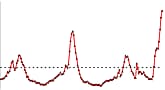
  • Visits to doctors for influenza-like illness (ILI) were highest in February during the 2008-09 flu season, but rose again in April 2009 after the new H1N1 virus emerged. Current visits to doctors for influenza-like illness are down from April, but are higher than what is expected in the summer and has increased over the last two weeks.
  • Total influenza hospitalization rates for adults and children are similar to or lower than seasonal influenza hospitalization rates depending on age group.
  • The proportion of deaths attributed to pneumonia and influenza (P&I) was low and within the bounds of what is expected in the summer.
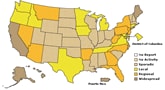
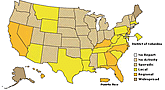
  • Most state health officials are reporting regional or sporadic influenza activity. Two states (Alaska and Georgia) and Puerto Rico are reporting widespread influenza activity at this time. Any reports of widespread influenza activity in August are very unusual.
  • Almost all of the influenza viruses identified were the new 2009 H1N1 influenza A viruses. These 2009 H1N1 viruses remain similar to the viruses chosen for the 2009 H1N1 vaccine and remain susceptible to antiviral drugs (oseltamivir and zanamivir) with rare exception.

Learn more >> 

U.S. Situation Update

Weekly Flu Activity Estimates

U.S. Patient Visits Reported for Influenza-like Illness (ILI)
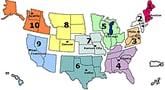
U.S. Influenza-like Illness (ILI) Reported by Regions
Total U.S. 2009 H1N1 Flu Hospitalizations and Deaths
Posted August 28, 2009, 1:00 PM ET
Data reported to CDC by August 27, 2009, 4:00 PM ET
Reporting States and Territories*
Hospitalized Cases
Deaths
52 
states and territories
8,843
hospitalized cases
556 
deaths

*Includes the District of Columbia, American Samoa, Guam, Puerto Rico and the U.S. Virgin Islands.

The number of hospitalized novel H1N1 cases and deaths presented in this table are an aggregate of reports received by CDC from U.S. states and territories and will be updated weekly each Friday at 11am. For state level information, refer to state health departments.

CDC discontinued reporting of individual confirmed and probable cases of novel H1N1 infection on July 24, 2009. CDC will report the total number of hospitalizations and deaths weekly, and continue to use its traditional surveillance systems to track the progress of the novel H1N1 flu outbreak.
For more information about CDC’s novel H1N1 influenza surveillance system, see
Questions & Answers About CDC's Novel H1N1 Influenza Surveillance.

International Human Cases of H1N1 Flu Infection
See:
World Health Organization.

For more information about the U.S. situation, see the CDC H1N1 Flu website.

International Situation Update

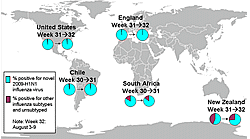
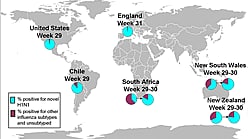
This situation report provides an update to the international situation as of August 28, 2009. As of August 23, the World Health Organization (WHO) regions have reported over 209,438 laboratory-confirmed cases of 2009 H1N1 influenza virus (2009 H1N1) with at least 2,185 deaths. The laboratory-confirmed cases represent an underestimation of total cases in the world as many countries now focus surveillance and laboratory testing only in persons with severe illness. The 2009 H1N1 influenza virus continues to be the dominant influenza virus in circulation in the world. Decreases in disease due to 2009 H1N1 continue to be reported from South America and parts of Australia. The United Kingdom is also reporting national decreases in disease due to 2009 H1N1. In contrast, disease associated with 2009 H1N1 influenza is continuing to increase in southern Africa and more Africa countries have reported their first cases. In addition, 2009 H1N1 continues to circulate in tropical countries.

For more information, see the International Situation Update >>

Recent Updates of Interest

Additional Updates on the CDC H1N1 Flu Website

To learn about other recent updates made to the CDC H1N1 Flu Website, please check the "What's New" page on the CDC H1N1 Flu website.


Modify/Update Email Preferences  |  Unsubscribe  |  Send Feedback  |  Learn more about CDC Email Updates
 
To receive the latest news for your region, please update your profile with your country, state and zip code.
 
Questions or problems?  Please contact support@govdelivery.com.
Centers for Disease Control and Prevention   Department of Health and Human Services


Centers for Disease Control and Prevention (CDC) · 1600 Clifton Rd · Atlanta GA 30333 · 800-CDC-INFO (800-232-4636)

Friday, August 21, 2009

CDC H1N1 Flu Website Situation Update, August 21

You are subscribed to updates from the Centers for Disease Control and Prevention (CDC).

Updated Guidance for Businesses and Employers 

CDC has released new guidance that recommends actions that non-healthcare employers should take now to decrease the spread of seasonal flu and 2009 H1N1 flu in the workplace and to help maintain business continuity during the 2009–2010 flu season. The guidance includes additional strategies to use if flu conditions become more severe and some new recommendations regarding when a worker who is ill with influenza may return to work. This guidance is available on the CDC website and on Flu.gov.

Learn more >>

Updated Guidance for Institutions of Higher Education 

CDC has released new guidance to help decrease the spread of flu among students, faculty, and staff of Institutions of Higher Education (IHE) and post-secondary educational institutions during the 2009-2010 academic year. The guidance expands upon earlier guidance for these settings by providing a menu of tools that IHE and health officials can choose from based on conditions in their area. It recommends actions to take now (during this academic year), suggests strategies to consider if flu severity is increasing compared with the spring/summer 2009 outbreak, and provides a checklist for making decisions. This guidance is available on the CDC website and on Flu.gov.

Learn more about the new Guidance and Toolkit >>

Key Flu Indicators

Each week CDC analyzes information about influenza disease activity in the United States and publishes findings of key flu indicators in a report called FluView. During the week of August 9-15, 2009, a review of these key indictors found that influenza activity had decreased slightly in the United States from the previous week. However, there were still higher levels of influenza activity than is normal for this time of year. Below is a summary of the most recent key indicators:

  • Visits to doctors for influenza-like illness (ILI) were highest in February during the 2008-09 flu season, but rose again in April 2009 after the new H1N1 virus emerged. Current visits to doctors for influenza-like illness are down from April, but are higher than what is expected in the summer.
  • Total influenza hospitalization rates for adults and children remain low and are well below the seasonal winter-time average of the last four years.
  • The proportion of deaths attributed to pneumonia and influenza (P&I) was low and within the bounds of what is expected in the summer.
  • Most state health officials are reporting local or sporadic influenza activity. Two states are reporting widespread influenza activity at this time. Any reports of widespread influenza activity in August are very unusual.
  • Almost all of the influenza viruses identified were the new 2009 H1N1 influenza A viruses. These 2009 H1N1 viruses remain similar to the viruses chosen for the 2009 H1N1 vaccine and remain susceptible to antiviral drugs (oseltamivir and zanamivir).

Learn more >> 

U.S. Situation Update

Weekly Flu Activity Estimates

U.S. Patient Visits Reported for Influenza-like Illness (ILI)

U.S. Influenza-like Illness (ILI) Reported by Regions

Total U.S. 2009 H1N1 Flu Hospitalizations and Deaths
Posted August 21, 2009, 11:00 AM ET
Data reported to CDC by August 20, 2009, 10:00 AM ET
Reporting States and Territories*
Hospitalized Cases
Deaths
53  7,983 522 

*Includes the District of Columbia, American Samoa, Guam, Puerto Rico and the U.S. Virgin Islands.

The number of hospitalized novel H1N1 cases and deaths presented in this table are an aggregate of reports received by CDC from U.S. states and territories and will be updated weekly each Friday at 11am. For state level information, refer to state health departments.

CDC discontinued reporting of individual confirmed and probable cases of novel H1N1 infection on July 24, 2009. CDC will report the total number of hospitalizations and deaths weekly, and continue to use its traditional surveillance systems to track the progress of the novel H1N1 flu outbreak.
For more information about CDC’s novel H1N1 influenza surveillance system, see
Questions & Answers About CDC's Novel H1N1 Influenza Surveillance.

International Human Cases of H1N1 Flu Infection
See:
World Health Organization.

For more information about the U.S. situation, see the CDC H1N1 Flu website.

International Situation Update

This situation report provides an update to the international situation as of August 21, 2009. As of August 13, the World Health Organization (WHO) regions have reported over 182,166 laboratory-confirmed cases of 2009 H1N1 influenza virus (2009 H1N1) with 1,799 deaths. The laboratory-confirmed cases represent an underestimation of total cases in the world as many countries now focus surveillance and laboratory testing only in persons with severe illness. The 2009 H1N1 influenza virus continues to be the dominant influenza virus in circulation in the world. Decreases in disease due to 2009 H1N1 continue to be reported from South America and parts of Australia. The United Kingdom is also reporting national decreases in disease due to 2009 H1N1. In contrast, disease associated with 2009 H1N1 influenza is continuing to increase in southern Africa and more Africa countries have reported their first cases. In addition, 2009 H1N1 continues to circulate in tropical countries.

Learn more >> 

Recent Updates of Interest

  • Weekly FluView Map and Surveillance Report for Week Ending August 15, 2009
    During week 32 (August 9-15, 2009), influenza activity remained stable in the United States; however, there were still higher levels of influenza-like illness than is normal for this time of year.
  • Audio and Transcript for August 21 CDC Press Briefing
    CDC Joint Briefing with NIH & FDA on 2009 H1N1 Influenza
  • Influenza A (H1N1) 2009 Monovalent Vaccine Safety Monitoring: CDC Planning for State, Local, Tribal, and Territorial Health Officials
    Vaccines to protect against the pandemic H1N1 2009 influenza virus are being developed. These influenza A (H1N1) 2009 monovalent vaccines (2009 H1N1 monovalent vaccines) and are anticipated to become available in the fall of 2009. The Advisory Committee on Immunization Practices (ACIP) has made recommendations regarding who should receive the 2009 H1N1 monovalent vaccine when it becomes available, including priorities for use of initial doses of vaccine.
  • 2009 H1N1 Flu: U.S. Situation Update
    As of 11:00 AM ET on August 21, 2009, CDC is reporting 7,983 hospitalized cases and 522 deaths in 53 states and territories (including the District of Columbia, American Samoa, Guam, Puerto Rico and the U.S. Virgin Islands).
  • 2009 H1N1 Flu: International Situation Update
    This situation report provides an update of the international situation as of August 21, 2009. World Health Organization (WHO) regions have reported 182,166 laboratory-confirmed cases of novel influenza A (H1N1) and 1,799 deaths.
  • Guidance for Responses to Influenza for Institutions of Higher Education during the 2009-2010 Academic Year
    CDC is releasing new guidance to help decrease the spread of flu among students, faculty, and staff of institutions of higher education (IHE) and post-secondary educational institutions during the 2009-2010 academic year.
  • Preparing for the Flu: A Communication Toolkit for Institutions of Higher Education
    The purpose of "Preparing for the Flu: A Communication Toolkit for Institutions of Higher Education" is to provide information and communication resources to help students, faculty, and staff implement recommendations from CDC's Guidance for Responses to Influenza for Institutions of Higher Education during the 2009-2010 Academic Year.
  • Technical Report on CDC Guidance for Responses to Influenza for Institutions of Higher Education during the 2009-2010 Academic Year
    This Technical Report includes detailed explanations of the strategies presented in the CDC Guidance for Responses to Influenza for Institutions of Higher Education during the 2009-2010 Academic Year and suggestions on how to use them. The guidance is designed to decrease exposure to regular seasonal flu and 2009 H1N1 flu while limiting the disruption of day-to-day activities and the vital academic activities that go on in Institutions of Higher Education (IHE). CDC will continue to monitor the situation and update the current guidance as more information is obtained on 2009 H1N1.
  • UPDATE: Novel H1N1 Flu: CDC Response
    CDC is taking aggressive action to respond to the new 2009 H1N1 influenza virus and a possibly severe upcoming flu season. CDC's response goals are to reduce the spread and severity of illness, and to provide information to help health care providers, public health officials and the public address the challenges posed by this public health threat. While the timing, spread and severity of the upcoming U.S. flu season are uncertain, CDC anticipates that 2009 H1N1 influenza viruses and regular seasonal influenza may spread at the same time. It's possible that a lot more people will get sick this season than normally occurs during a regular flu season. There also may be more people hospitalized and more deaths this season than during a normal flu season.
  • Guidance for Businesses and Employers to Plan and Respond to the 2009-2010 Influenza Season
    CDC is releasing new guidance that recommends actions that non-healthcare employers should take now to decrease the spread of seasonal flu and 2009 H1N1 flu in the workplace and to help maintain business continuity during the 2009-2010 flu season. The guidance includes additional strategies to use if flu conditions become more severe and some new recommendations regarding when a worker who is ill with influenza may return to work. The guidance in this document may change as additional information about the severity of the 2009-2010 influenza season and the impact of 2009 H1N1 influenza become known. Please check www.flu.gov periodically for updated guidance.
  • Preparing for the Flu: A Communication Toolkit for Businesses and Employers
    The purpose of "Preparing for the Flu: A Communication Toolkit for Businesses and Employers" is to provide information and communication resources to help businesses and employers implement recommendations from CDC's Guidance for Businesses and Employers to Plan and Respond to the 2009-2010 Influenza Season.

Additional Updates on the CDC H1N1 Flu Website

To learn about other recent updates made to the CDC H1N1 Flu Website, please check the "What's New" page on the CDC H1N1 Flu website.


Modify/Update Email Preferences  |  Unsubscribe  |  Send Feedback  |  Learn more about CDC Email Updates
 
To receive the latest news for your region, please update your profile with your country, state and zip code.
 
Questions or problems?  Please contact support@govdelivery.com.
Centers for Disease Control and Prevention   Department of Health and Human Services


Centers for Disease Control and Prevention (CDC) · 1600 Clifton Rd · Atlanta GA 30333 · 800-CDC-INFO (800-232-4636)
Friday, August 14, 2009

CDC H1N1 Flu Website Situation Update, August 14, 2009

You are subscribed to updates from the Centers for Disease Control and Prevention (CDC).

Vaccination Recommendations

With the new H1N1 virus continuing to cause illness, hospitalizations and deaths in the U.S. during the normally flu-free summer months and some uncertainty and about what the upcoming flu season might bring, CDC's Advisory Committee on Immunization Practices has taken an important step in preparations for a voluntary novel H1N1 vaccination effort to counter a possibly severe upcoming flu season. On July 29, ACIP met to consider who should receive novel H1N1 vaccine when it becomes available.

Learn more >> 

U.S. Situation Update

Weekly Flu Activity Estimates

U.S. Patient Visits Reported for Influenza-like Illness (ILI)

U.S. Influenza-like Illness (ILI) Reported by Regions

Total U.S. Novel H1N1 Flu Hospitalizations and Deaths
Posted August 14, 2009, 11:00 AM ET
Data reported to CDC by August 13, 2009, 2:00 PM ET
Reporting States and Territories*
Hospitalized Cases
Deaths
51  7,511 477

*Includes the District of Columbia, American Samoa, Guam, Puerto Rico and the U.S. Virgin Islands.

The number of hospitalized novel H1N1 cases and deaths presented in this table are an aggregate of reports received by CDC from U.S. states and territories and will be updated weekly each Friday at 11am. For state level information, refer to state health departments.

CDC discontinued reporting of individual confirmed and probable cases of novel H1N1 infection on July 24, 2009. CDC will report the total number of hospitalizations and deaths weekly, and continue to use its traditional surveillance systems to track the progress of the novel H1N1 flu outbreak.
For more information about CDC’s novel H1N1 influenza surveillance system, see
Questions & Answers About CDC's Novel H1N1 Influenza Surveillance.

International Human Cases of H1N1 Flu Infection
See:
World Health Organization.

For more information about the U.S. situation, see the CDC H1N1 Flu website.

International Situation Update

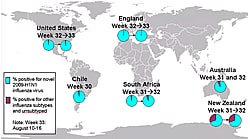
This situation report provides an update to the international situation as of August 14, 2009. World Health Organization (WHO) regions have reported 177,457 laboratory-confirmed cases of novel 2009-H1N1 influenza virus (new H1N1) with 1,462 deaths. The laboratory-confirmed cases represent an underestimation of total cases in the world as many countries have shifted to strategies of clinical confirmation and prioritization of laboratory testing for only persons with severe illness and/or high risk conditions. The new H1N1 influenza virus is the dominant influenza virus in circulation in the world. According to a WHO Global Influenza Surveillance Network (GISN) report dated August 4th, 71% of all influenza viruses currently detected globally are the new H1N1. The new H1N1 accounts for 66% of influenza viruses in the Northern Hemisphere and 89% of influenza viruses in the Southern Hemisphere. There are indications that disease may be decreasing in South America and part of Australia. Disease associated with new H1N1 influenza is continuing to increase in southern Africa.

Recent Updates of Interest

  • Weekly FluView Map and Surveillance Report for Week Ending August 8, 2009
    During week 31 (August 2-8, 2009), influenza activity decreased in the United States, however, there were still higher levels of influenza-like illness than is normal for this time of year.
  • Novel H1N1 Flu: U.S. Situation Update
    As of 11:00 AM ET on August 14, 2009, CDC is reporting 7,511 hospitalized cases and 477 deaths in 51 states and territories (including the District of Columbia, American Samoa, Guam, Puerto Rico and the U.S. Virgin Islands).
  • Novel H1N1 Flu: International Situation Update
    This situation report provides an update of the international situation as of August 14, 2009. World Health Organization (WHO) regions have reported 177,457 laboratory-confirmed cases of novel influenza A (H1N1) and 1,462 deaths.
  • Doses Administered Reporting [PDF 559KB]
    The purpose of this document is to describe the doses administering monitoring requirements, describe options for collecting data, and outline key planning steps. The target audience is CRA doses administered coordinators points of contact, and their supervisors, immunization program managers, immunization information systems staff, and preparedness coordinators.
  • CDC Novel H1N1 Vaccination Planning Q&A
    Information for professionals on planning and preparing for H1N1 vaccination.
  • UPDATE General Business and Workplace Guidance for the Prevention of Novel Influenza A (H1N1) Flu in Workers
    This guidance is to help employers with employees in OSHA's Lower Risk (Caution) Zone: those employees who have minimal occupational contact with the general public and other coworkers (for example, office employees).
  • Novel H1N1 Flu: CDC Response
    CDC continues to take aggressive action to respond to the outbreak. CDC's response goals are to reduce the spread and severity of illness, and to provide information to help health care providers, public health officials and the public address the challenges posed by this new public health threat.

Additional Updates on the CDC H1N1 Flu Website

To learn about other recent updates made to the CDC H1N1 Flu Website, please check the "What's New" page on the CDC H1N1 Flu website.


Modify/Update Email Preferences  |  Unsubscribe  |  Send Feedback  |  Learn more about CDC Email Updates
 
To receive the latest news for your region, please update your profile with your country, state and zip code.
 
Questions or problems?  Please contact support@govdelivery.com.
Centers for Disease Control and Prevention   Department of Health and Human Services


Centers for Disease Control and Prevention (CDC) · 1600 Clifton Rd · Atlanta GA 30333 · 800-CDC-INFO (800-232-4636)

Friday, August 7, 2009

CDC H1N1 Flu Website Situation Update, August 7, 2009

You are subscribed to updates from the Centers for Disease Control and Prevention (CDC).

Updated Guidance for K-12 Schools for the Fall Flu Season

Updated federal guidelines offer state and local public health and school officials a range of options for responding to 2009 H1N1 influenza in schools, depending on how severe the flu may be in their communities. The guidance says officials should balance the risk of flu in their communities with the disruption that school dismissals will cause in education and the wider community.

Recommendations for the Amount of Time Persons with Flu-Like Illness Should be Away from Others

CDC recommends that people with influenza-like illness remain at home until at least 24 hours after they are free of fever (100° F [37.8°C]), or signs of a fever without the use of fever-reducing medications. This is a change from the previous recommendation that ill persons stay home for 7 days after illness onset or until 24 hours after the resolution of symptoms, whichever was longer. The new recommendation applies to camps, schools, businesses, mass gatherings, and other community settings where the majority of people are not at increased risk for influenza complications.

Learn more >>

U.S. Situation Update

Weekly Flu Activity Estimates

U.S. Patient Visits Reported for Influenza-like Illness (ILI)

U.S. Influenza-like Illness (ILI) Reported by Regions

Total U.S. Novel H1N1 Flu Hospitalizations and Deaths
Posted August 7, 2009, 11:00 AM ET
Data reported to CDC by August 6, 2009, 11:00 AM ET
Reporting States and Territories*
Hospitalized Cases
Deaths
50  6,506 436 

*Includes the District of Columbia, American Samoa, Guam, Puerto Rico and the U.S. Virgin Islands.

The number of hospitalized novel H1N1 cases and deaths presented in this table are an aggregate of reports received by CDC from U.S. states and territories and will be updated weekly each Friday at 11am. For state level information, refer to state health departments.

CDC discontinued reporting of individual confirmed and probable cases of novel H1N1 infection on July 24, 2009. CDC will report the total number of hospitalizations and deaths weekly, and continue to use its traditional surveillance systems to track the progress of the novel H1N1 flu outbreak.
For more information about CDC’s novel H1N1 influenza surveillance system, see
Questions & Answers About CDC's Novel H1N1 Influenza Surveillance.

International Human Cases of H1N1 Flu Infection
See:
World Health Organization.

For more information about the U.S. situation, see the CDC H1N1 Flu Website.

International Situation Update

This situation report provides an update to the international situation as of August 4, 2009. World Health Organization (WHO) regions have reported 162,380 laboratory-confirmed cases of novel influenza A (H1N1) and 1,154 deaths. The laboratory-confirmed cases represent an underestimation of total cases in the world as many countries have shifted to strategies of clinical confirmation and prioritization of laboratory testing for only persons with severe illness and/or high risk conditions. The novel influenza A (H1N1) virus is the dominant influenza virus in circulation in the United States, England, South Africa, New Zealand, Australia, Chile, Argentina and Brazil. South Africa has had a notable increase in the proportion of influenza that is novel influenza A (H1N1), and now it represents the majority of influenza in the country. Many seasonal influenza viruses from these countries have not been subtyped. Of those that have been subtyped in Australia, South Africa, and Argentina, the most common seasonal influenza virus is influenza A (H3N2).

For more information about the U.S. situation, see the CDC H1N1 Flu International Situation Update Page.

Recent Updates of Interest

  • Weekly FluView Map and Surveillance Report for Week Ending August 1, 2009
    During week 30 (July 26-August 1, 2009), influenza activity decreased in the United States, however, there were still higher levels of influenza-like illness than is normal for this time of year.
  • Preparing for the Flu: A Communication Toolkit for Schools (Grades K-12)
    The purpose of "Preparing for the Flu: A Communication Toolkit for Schools" is to provide basic information and communication resources to help school administrators implement recommendations from CDC's Guidance for State and Local Public Health Officials and School Administrators for School (K-12) Responses to Influenza during the 2009-2010 School Year.
  • Technical Report for State and Local Public Health Officials and School Administrators on CDC Guidance for School (K-12) Responses to Influenza during the 2009-2010 School Year
    This Technical Report includes detailed information on the reasons for the strategies presented in the CDC Guidance for School (K-12) Responses to Influenza During the 2009-2010 School Year and suggestions on how to use them. The guidance is designed to decrease exposure to regular seasonal flu and 2009 H1N1 flu while limiting the disruption of day-to-day activities and the vital learning that goes on in schools. CDC will continue to monitor the situation and update the current guidance as more information is obtained on 2009 H1N1.
  • CDC Guidance for State and Local Public Health Officials and School Administrators for School (K-12) Responses to Influenza during the 2009-2010 School Year
    This document provides guidance to help decrease the spread of flu among students and school staff during the 2009-2010 school year. This document expands upon earlier school guidance documents by providing a menu of tools that school and health officials can choose from based on conditions in their area. It recommends actions to take this school year and suggests strategies to use if CDC finds that the flu starts causing more severe disease. The guidance also provides a checklist for making decisions at the local level.
  • UPDATE: Novel H1N1 Flu and You
    Revised to reflect CDC's new recommendations for the amount of time persons with influenza-like illness should be away from others. CDC recommends that people with influenza-like illness remain at home until at least 24 hours after they are free of fever (100 degrees F or 37.8 degrees C), or signs of a fever without the use of fever-reducing medications. This is a change from the previous recommendation that ill persons stay home for 7 days after illness onset or until 24 hours after the resolution of symptoms, whichever was longer.
  • CDC Recommendations for the Amount of Time Persons with Influenza-Like Illness Should be Away from Others
    CDC recommends that people with influenza-like illness remain at home until at least 24 hours after they are free of fever (100 degrees F or 37.8 degrees C), or signs of a fever without the use of fever-reducing medications. This is a change from the previous recommendation that ill persons stay home for 7 days after illness onset or until 24 hours after the resolution of symptoms, whichever was longer. The new recommendation applies to camps, schools, businesses, mass gatherings, and other community settings where the majority of people are not at increased risk for influenza complications. This guidance does not apply to health care settings where the exclusion period should be continued for 7 days from symptom onset or until the resolution of symptoms, whichever is longer.
  • School Dismissal Monitoring System
    CDC and the U.S. Department of Education, in collaboration with state and local health and education agencies and national non-governmental organizations, have implemented a school dismissal monitoring system for the 2009-2010 school year. This monitoring system generates real-time, national summary data daily on the number of school dismissals and the number of impacted students and teachers.
  • Planning and Preparing for Novel H1N1 Vaccination
    Information for professionals on planning and preparing for H1N1 vaccination.

Additional Updates on the CDC H1N1 Flu Website

To learn about other recent updates made to the CDC H1N1 Flu Website, please check the "What's New" page on the CDC H1N1 Flu website.


Modify/Update Email Preferences  |  Unsubscribe  |  Send Feedback  |  Learn more about CDC Email Updates
 
To receive the latest news for your region, please update your profile with your country, state and zip code.
 
Questions or problems?  Please contact support@govdelivery.com.
Centers for Disease Control and Prevention   Department of Health and Human Services


Centers for Disease Control and Prevention (CDC) · 1600 Clifton Rd · Atlanta GA 30333 · 800-CDC-INFO (800-232-4636)