Saturday, December 19, 2009

CDC H1N1 Flu Website Situation Update, December 19, 2009

You are subscribed to updates from the Centers for Disease Control and Prevention (CDC).

CDC H1N1 Flu Website Situation Update, December 19, 2009

Key Flu Indicators

Each week CDC analyzes information about influenza disease activity in the United States and publishes findings of key flu indicators in a report called FluView. During the week of December 6-12, 2009, influenza activity decreased over the previous week across all key indicators. Most indicators, however, remain higher than normal for this time of year. Below is a summary of the most recent key indicators:

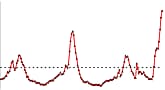
  • Visits to doctors for influenza-like illness (ILI) nationally decreased slightly this week over last week. This is the seventh consecutive week of national decreases in ILI after four consecutive weeks of sharp increases. While ILI has declined, visits to doctors for influenza-like illness remain slightly elevated nationally.
  • Influenza hospitalizations and hospitalization rates decreased in all age groups.
  • The proportion of deaths attributed to pneumonia and influenza (P&I) based on the 122 Cities Report decreased over the previous week, but remains elevated for this time of year. This proportion has been higher than expected for eleven consecutive weeks. In addition, 9 flu-related pediatric deaths were reported this week: 8 of these deaths were associated with laboratory confirmed 2009 H1N1, and one was associated with an influenza A virus that was not subtyped. Since April 2009, CDC has received reports of 276 laboratory-confirmed pediatric deaths: 232 due to 2009 H1N1, 42 pediatric deaths that were laboratory confirmed as influenza, but the flu virus subtype was not determined, and two pediatric deaths that were associated with seasonal influenza viruses. Laboratory-confirmed deaths are thought to represent an undercount of the actual number. CDC has provided estimates about the number of 2009 H1N1 cases and related hospitalizations and deaths.
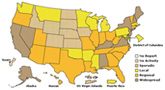
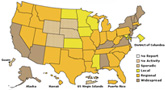
  • Eleven states are reporting widespread influenza activity; a decline of three states from last week. They are: Alabama, Alaska, California, Delaware, Kentucky, Maine, New Hampshire, New Jersey, Nevada, New York, and Virginia
  • Almost all of the influenza viruses identified so far continue to be 2009 H1N1 influenza A viruses. These viruses remain similar to the virus chosen for the 2009 H1N1 vaccine, and remain susceptible to the antiviral drugs oseltamivir and zanamivir with rare exception.

*All data are preliminary and may change as more reports are received.

Learn more >> 

U.S. Situation Update

Weekly Flu Activity Estimates

U.S. Patient Visits Reported for Influenza-like Illness (ILI)
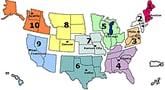
U.S. Influenza-like Illness (ILI) Reported by Regions
U.S. Laboratory Confirmed Influenza-Associated Hospitalizations
and Deaths from August 30 to December 12, 2009

Posted December 18, 2009, 11:00 AM ET
Data reported to CDC by December 15, 2009, 12:00 AM ET
Cases Defined by
Hospitalizations
Deaths
Influenza Laboratory-Tests** 35,309 1,567

*Reports can be based on syndromic, admission or discharge data, or a combination of data elements that could include laboratory-confirmed and influenza-like illness hospitalizations.

*Laboratory confirmation includes any positive influenza test (rapid influenza tests, RT-PCR, DFA, IFA, or culture), whether or not typing was done.

The table shows aggregate reports of all laboratory confirmed influenza hospitalizations and deaths (including 2009 H1N1 and seasonal flu) since August 30, 2009 received by CDC from U.S. states and territories**. This table will be updated weekly each Friday at 11 a.m. For the 2009-2010 influenza season, states are reporting based on new case definitions for hospitalizations and deaths effective August 30, 2009.

CDC will continue to use its traditional surveillance systems to track the progress of the 2009-2010 influenza season. For more information about influenza surveillance, including reporting of influenza-associated hospitalizations and deaths, see Questions and Answers: Monitoring Influenza Activity, Including 2009 H1N1.

The number of 2009 H1N1 hospitalizations and deaths reported to CDC from April – August 2009 is available on the Past Situation Updates page.

For state level information, refer to state health departments.

International Human Cases of 2009 H1N1 Flu Infection
See: World Health Organization.

**States report weekly to CDC either 1) laboratory-confirmed influenza hospitalizations and deaths or 2) pneumonia and influenza syndrome-based cases of hospitalization and death resulting from all types or subtypes of influenza. Although only the laboratory confirmed cases are included in this report, CDC continues to analyze data both from laboratory confirmed and syndromic hospitalizations and deaths.


U.S. Influenza-associated Pediatric Mortality
Posted December 18, 2009 (Updated each Friday)
Data reported to CDC by December 12, 2009
Date Reported
Laboratory-Confirmed 2009 H1N1 Influenza Pediatric Deaths
Laboratory-Confirmed Influenza A Subtype Unknown Pediatric Deaths
Laboratory-Confirmed
Seasonal
Influenza
Total
This Week (Week 49, December 6-12, 2009) 8 1 0 9
Since August 30, 2009 172 39 1 212
Cumulative since April 26, 2009 232 42 2 276

This table is based on data reported to CDC through the Influenza-Associated Pediatric Mortality Surveillance System. Influenza-associated deaths in children (persons less than 18 years) was added as nationally notifiable condition in 2004.

For more information about influenza-associated pediatric mortality, see FluView.

For more information about the U.S. situation, see the CDC H1N1 Flu U.S. Situation page.

International Situation Update
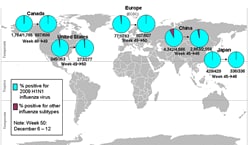
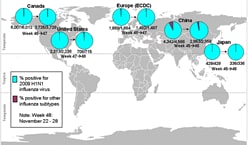
This report provides an update to the international situation as of December 18, 2009. The World Health Organization (WHO) continues to report laboratory-confirmed 2009 H1N1 flu cases and deaths on its Web page. These laboratory-confirmed cases represent a substantial underestimation of total cases in the world, as most countries focus surveillance and laboratory testing only on people with severe illness. The 2009 H1N1 influenza virus continues to be the dominant influenza virus in circulation in the world. For the most recent period in which data are available, from November 15 to December 5, 2009, 92.2% of influenza specimens reported to WHO were 2009 H1N1, 1% were seasonal A (H1), 0.9% were A (H3), 5.2% were influenza A viruses that were not subtyped, and 0.8% were influenza B viruses. In temperate regions of the Southern Hemisphere, sporadic cases of 2009 H1N1 have been reported in recent weeks but no sustained transmission has been observed. In tropical regions of the Americas and Asia, influenza activity due to 2009 H1N1 remains variable. In temperate regions of the Northern Hemisphere, influenza-like illness (ILI) activity due to 2009 H1N1 has passed its peak in North America and in parts of Western and Northern Europe, but activity continues to increase in parts of Central and Southeastern Europe, as well as in South and Central Asia.

For more information about the international situation, see the CDC H1N1 Flu International Situation page.

CDC Experts Contributing to WebMD's Focus on Flu Blog

Follow CDC Experts on WebMDs Flu Blog – Visit NowIn collaboration with WebMD, experts from the Centers for Disease Control and Prevention are guest blogging and helping to answer questions on WebMD's Focus on Flu Blog. Check out recent CDC blog post by Anthony Fiore, MD, MPH, medical epidemiologist with the CDC's Influenza Division -- Data show H1N1 vaccine is as safe as the seasonal flu vaccines.

Recent Updates of Interest

Additional Updates on the CDC H1N1 Flu Website

To learn about other recent updates made to the CDC H1N1 Flu Website, please check the "What's New" page on the CDC H1N1 Flu website.


Get H1N1 Updates & Health Tips via Text Message

For CDC Info, Text 'Health' to 87000. www.flu.govSign up to get health updates sent via text message. Messages are sent about three times a week with relevant H1N1 flu updates and timely health tips.

Text UPDATES to 87000 to sign up.

To learn more, see www.cdc.gov/mobile.


Modify/Update Subscriber Preferences  |  Unsubscribe  |  Send Feedback  |  Learn more about CDC Email Updates
 
To receive the latest news for your region, please update your profile with your country, state and zip code.
 
Questions or problems?  Please contact support@govdelivery.com.

Department of Health and Human Services

Fight Flu with Facts! • Visit Flu.gov
Call 800-232-4636 • Text UPDATES to 87000

Centers for Disease Control and Prevention

Centers for Disease Control and Prevention (CDC) · 1600 Clifton Rd · Atlanta GA 30333 · 800-CDC-INFO (800-232-4636)
Friday, December 11, 2009

CDC H1N1 Flu Website Situation Update, December 11, 2009

You are subscribed to updates from the Centers for Disease Control and Prevention (CDC).

CDC H1N1 Flu Website Situation Update, December 11, 2009

Key Flu Indicators

Each week CDC analyzes information about influenza disease activity in the United States and publishes findings of key flu indicators in a report called FluView. During the week of November 29-December 5, 2009, influenza activity decreased over the previous week across all key indicators except for deaths, but most indicators remain higher than normal for this time of year. Below is a summary of the most recent key indicators:

  • Visits to doctors for influenza-like illness (ILI) nationally decreased again this week over last week. This is the sixth consecutive week of national decreases in ILI after four consecutive weeks of sharp increases. While ILI has declined, visits to doctors for influenza-like illness remain elevated nationally.
  • Influenza hospitalization rates have decreased across all age groups but remain higher than expected for this time of year. Though declining, hospitalization rates continue to be highest in children 0-4 years old.
  • The proportion of deaths attributed to pneumonia and influenza (P&I) based on the 122 Cities Report increased over the previous week and has been higher than expected for ten consecutive weeks. In addition, 16 flu-related pediatric deaths were reported this week: 13 of these deaths were associated with laboratory confirmed 2009 H1N1, 2 were associated with influenza A viruses that were not subtyped and one was associated with a seasonal influenza B virus. Since April 2009, CDC has received reports of 267 laboratory-confirmed pediatric deaths: 224 due to 2009 H1N1, 41 pediatric deaths that were laboratory confirmed as influenza, but the flu virus subtype was not determined, and two pediatric deaths were associated with seasonal influenza viruses. (Laboratory-confirmed deaths are thought to represent an undercount of the actual number. CDC has provided estimates about the number of 2009 H1N1 cases and related hospitalizations and deaths. The increase in the proportion of deaths as other indicators are going down is not surprising as the occurrence and reporting of deaths usually lags behind that of other indicators.
  • Fourteen states are reporting widespread influenza activity; a decline of 11 states from last week. They are: Alabama, Alaska, Arizona, California, Connecticut, Delaware, Kentucky, Maine, New Hampshire, New Jersey, New York, Rhode Island, Vermont, and Virginia
  • Almost all of the influenza viruses identified so far continue to be 2009 H1N1 influenza A viruses. These viruses remain similar to the virus chosen for the 2009 H1N1 vaccine, and remain susceptible to the antiviral drugs oseltamivir and zanamivir with rare exception.

*All data are preliminary and may change as more reports are received.

Learn more >> 

U.S. Situation Update

Weekly Flu Activity Estimates

U.S. Patient Visits Reported for Influenza-like Illness (ILI)

U.S. Influenza-like Illness (ILI) Reported by Regions

U.S. Laboratory Confirmed Influenza-Associated Hospitalizations
and Deaths from August 30 to December 5, 2009

Posted December 11, 2009, 11:00 AM ET
Data reported to CDC by December 8, 2009, 12:00 AM ET
Cases Defined by
Hospitalizations
Deaths
Influenza Laboratory-Tests** 33,490 1,445

*Reports can be based on syndromic, admission or discharge data, or a combination of data elements that could include laboratory-confirmed and influenza-like illness hospitalizations.

*Laboratory confirmation includes any positive influenza test (rapid influenza tests, RT-PCR, DFA, IFA, or culture), whether or not typing was done.

The table shows aggregate reports of all laboratory confirmed influenza hospitalizations and deaths (including 2009 H1N1 and seasonal flu) since August 30, 2009 received by CDC from U.S. states and territories**. This table will be updated weekly each Friday at 11 a.m. For the 2009-2010 influenza season, states are reporting based on new case definitions for hospitalizations and deaths effective August 30, 2009.

CDC will continue to use its traditional surveillance systems to track the progress of the 2009-2010 influenza season. For more information about influenza surveillance, including reporting of influenza-associated hospitalizations and deaths, see Questions and Answers: Monitoring Influenza Activity, Including 2009 H1N1.

The number of 2009 H1N1 hospitalizations and deaths reported to CDC from April – August 2009 is available on the Past Situation Updates page.

For state level information, refer to state health departments.

International Human Cases of 2009 H1N1 Flu Infection
See:
World Health Organization.

**States report weekly to CDC either 1) laboratory-confirmed influenza hospitalizations and deaths or 2) pneumonia and influenza syndrome-based cases of hospitalization and death resulting from all types or subtypes of influenza. Although only the laboratory confirmed cases are included in this report, CDC continues to analyze data both from laboratory confirmed and syndromic hospitalizations and deaths.


U.S. Influenza-associated Pediatric Mortality
Posted December 11, 2009 (Updated each Friday)
Data reported to CDC by December 5, 2009
Date Reported
Laboratory-Confirmed 2009 H1N1 Influenza Pediatric Deaths
Laboratory-Confirmed Influenza A Subtype Unknown Pediatric Deaths
Laboratory-Confirmed
Seasonal
Influenza
Total
This Week  (Week 48, November 29-December 5, 2009) 13 2 1 16
Since August 30, 2009 165 38 1 204
Cumulative since April 26, 2009 224 41 2 267

This table is based on data reported to CDC through the Influenza-Associated Pediatric Mortality Surveillance System. Influenza-associated deaths in children (persons less than 18 years) was added as nationally notifiable condition in 2004.

For more information about influenza-associated pediatric mortality, see FluView.

For more information about the U.S. situation, see the CDC H1N1 Flu U.S. Situation page.

International Situation Update

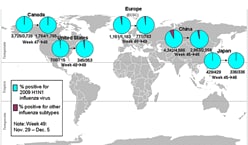
This report provides an update to the international situation as of December 11, 2009. The World Health Organization (WHO) continues to report laboratory-confirmed 2009 H1N1 flu cases and deaths on its Web page. These laboratory-confirmed cases represent a substantial underestimation of total cases in the world, as many countries focus surveillance and laboratory testing only on people with severe illness. The 2009 H1N1 influenza virus continues to be the predominant influenza virus in circulation in the world. For the most recent week in which data are available (November 22 to November 28, 2009) more than 89.4% of influenza specimens reported to WHO were 2009 H1N1. In temperate regions of the Southern Hemisphere, sporadic cases of 2009 H1N1 have been reported in recent weeks but no sustained transmission has been observed. In tropical regions of the Americas and Asia, influenza activity due to 2009 H1N1 remains variable. In temperate regions of the Northern Hemisphere, influenza-like illness (ILI) activity due to 2009 H1N1 has passed its highest peak in North America and in parts of Western, Northern, and Eastern Europe, but activity continues to increase in parts of Central and Southeastern Europe, as well as in South and East Asia.

For more information about the international situation, see the CDC H1N1 Flu International Situation page.

CDC Experts Contributing to WebMD's Focus on Flu Blog

Follow CDC Experts on WebMDs Flu Blog – Visit NowIn collaboration with WebMD, experts from the Centers for Disease Control and Prevention are guest blogging and helping to answer questions on WebMD's Focus on Flu Blog. Check out recent CDC blog posts by Anthony Fiore, MD, MPH, medical epidemiologist with the CDC's Influenza Division -- "How Many People Have Had H1N1 Flu?" and "Children and H1N1 Flu."

Recent Updates of Interest

Additional Updates on the CDC H1N1 Flu Website

To learn about other recent updates made to the CDC H1N1 Flu Website, please check the "What's New" page on the CDC H1N1 Flu website.


Get H1N1 Updates & Health Tips via Text Message

For CDC Info, Text 'Health' to 87000. www.flu.govSign up to get health updates sent via text message. Messages are sent about three times a week with relevant H1N1 flu updates and timely health tips.

Text UPDATES to 87000 to sign up.

To learn more, see www.cdc.gov/mobile.


Modify/Update Subscriber Preferences  |  Unsubscribe  |  Send Feedback  |  Learn more about CDC Email Updates
 
To receive the latest news for your region, please update your profile with your country, state and zip code.
 
Questions or problems?  Please contact support@govdelivery.com.

Department of Health and Human Services

Fight Flu with Facts! • Visit Flu.gov
Call 800-232-4636 • Text UPDATES to 87000

Centers for Disease Control and Prevention

Centers for Disease Control and Prevention (CDC) · 1600 Clifton Rd · Atlanta GA 30333 · 800-CDC-INFO (800-232-4636)
Saturday, December 5, 2009

CDC H1N1 Flu Website Situation Update, December 5, 2009

You are subscribed to updates from the Centers for Disease Control and Prevention (CDC).

CDC H1N1 Flu Website Situation Update, December 5, 2009

Key Flu Indicators

Each week CDC analyzes information about influenza disease activity in the United States and publishes findings of key flu indicators in a report called FluView. During the week of November 22-28, 2009, influenza activity decreased across all key indicators over the previous week, but most indicators remain higher than normal for this time of year. Below is a summary of the most recent key indicators:

  • Visits to doctors for influenza-like illness (ILI) nationally decreased again this week over last week. This is the fifth consecutive week of national decreases in ILI after four consecutive weeks of sharp increases. Eight of ten regions continue to report ILI activity above what is expected for this time of year. Two regions (Region 6 and Region 10) are reporting little ILI activity. While ILI has declined, visits to doctors for influenza-like illness still remain elevated nationally.
  • Influenza hospitalization rates have decreased across all age groups but remain higher than expected for this time of year. Though declining, hospitalization rates continue to be highest in children 0-4 years old.
  • The proportion of deaths attributed to pneumonia and influenza (P&I) based on the 122 Cities Report declined over the previous week, but continues to be higher than expected for this time of year. This is the ninth consecutive week that the proportion of deaths attributed to pneumonia and influenza (P&I) has been above the epidemic threshold.  In addition, 17 flu-related pediatric deaths were reported this week: 12 of these deaths were associated with laboratory confirmed 2009 H1N1 and 5 were associated with influenza A viruses, but were not subtyped. Since April 2009, CDC has received reports of 251 laboratory-confirmed pediatric deaths:  210 due to 2009 H1N1, 40 pediatric deaths that were laboratory confirmed as influenza, but the flu virus subtype was not determined, and one pediatric death associated with a seasonal influenza virus. (Laboratory-confirmed deaths are thought to represent an undercount of the actual number. CDC has provided estimates about the number of 2009 H1N1 cases and related hospitalizations and deaths.
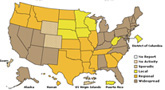
  • Twenty-five states are reporting widespread influenza activity; a decline of 7 states from last week. They are: Alabama, Alaska, Arizona, California, Connecticut, Delaware, Florida, Indiana, Kentucky, Maine, Maryland, Massachusetts, Michigan, Nevada, New Hampshire, New Jersey, New Mexico, New York, North Carolina, Ohio, Pennsylvania, Rhode Island, Utah, Vermont, and Virginia. Seventeen states are reporting regional influenza activity, the District of Columbia, Puerto Rico and six states reported local influenza activity, and Guam, the U.S. Virgin Islands and two states reported sporadic influenza activity.
  • Almost all of the influenza viruses identified so far continue to be 2009 H1N1 influenza A viruses. These viruses remain similar to the virus chosen for the 2009 H1N1 vaccine, and remain susceptible to the antiviral drugs oseltamivir and zanamivir with rare exception.

*All data are preliminary and may change as more reports are received.

Learn more >> 

U.S. Situation Update

Weekly Flu Activity Estimates

U.S. Patient Visits Reported for Influenza-like Illness (ILI)

U.S. Influenza-like Illness (ILI) Reported by Regions

U.S. Laboratory Confirmed Influenza-Associated Hospitalizations
and Deaths from August 30 to November 28, 2009

Posted December 4, 2009, 11:00 AM ET
Data reported to CDC by December 2, 2009, 12:00 AM ET
Cases Defined by
Hospitalizations
Deaths
Influenza Laboratory-Tests** 31,320 1,336

*Reports can be based on syndromic, admission or discharge data, or a combination of data elements that could include laboratory-confirmed and influenza-like illness hospitalizations.

*Laboratory confirmation includes any positive influenza test (rapid influenza tests, RT-PCR, DFA, IFA, or culture), whether or not typing was done.

The table shows aggregate reports of all laboratory confirmed influenza hospitalizations and deaths (including 2009 H1N1 and seasonal flu) since August 30, 2009 received by CDC from U.S. states and territories**. This table will be updated weekly each Friday at 11 a.m. For the 2009-2010 influenza season, states are reporting based on new case definitions for hospitalizations and deaths effective August 30, 2009.

CDC will continue to use its traditional surveillance systems to track the progress of the 2009-2010 influenza season. For more information about influenza surveillance, including reporting of influenza-associated hospitalizations and deaths, see Questions and Answers: Monitoring Influenza Activity, Including 2009 H1N1.

The number of 2009 H1N1 hospitalizations and deaths reported to CDC from April – August 2009 is available on the Past Situation Updates page.

For state level information, refer to state health departments.

International Human Cases of 2009 H1N1 Flu Infection
See: World Health Organization.

**States report weekly to CDC either 1) laboratory-confirmed influenza hospitalizations and deaths or 2) pneumonia and influenza syndrome-based cases of hospitalization and death resulting from all types or subtypes of influenza. Although only the laboratory confirmed cases are included in this report, CDC continues to analyze data both from laboratory confirmed and syndromic hospitalizations and deaths.


U.S. Influenza-associated Pediatric Mortality
Posted December 4, 2009 (Updated each Friday)
Data reported to CDC by November 28, 2009
Date Reported
Laboratory-Confirmed 2009 H1N1 Influenza Pediatric Deaths
Laboratory-Confirmed Influenza A Subtype Unknown Pediatric Deaths
Laboratory-Confirmed
Seasonal
Influenza
Total
This Week (Week 47, November 22-28, 2009) 12 5 0 17
Since August 30, 2009 152 37 0 189
Cumulative since April 26, 2009 210 40 1 251

This table is based on data reported to CDC through the Influenza-Associated Pediatric Mortality Surveillance System. Influenza-associated deaths in children (persons less than 18 years) was added as nationally notifiable condition in 2004.

For more information about influenza-associated pediatric mortality, see FluView.

For more information about the U.S. situation, see the CDC H1N1 Flu U.S. Situation page.

International Situation Update

This report provides an update to the international situation as of December 4, 2009. The World Health Organization (WHO) continues to report laboratory-confirmed 2009 H1N1 flu cases and deaths on its Web page. These laboratory-confirmed cases represent a substantial underestimation of total cases in the world, as many countries focus surveillance and laboratory testing only on people with severe illness. The 2009 H1N1 influenza virus continues to be the dominant influenza virus in circulation in the world. From April 19 to November 21, 2009, 71.4% of influenza specimens reported to WHO were 2009 H1N1 viruses and from November 15 to November 21, 2009, more than 93% of influenza specimens reported to WHO were 2009 H1N1. In temperate regions of the Southern Hemisphere, little disease activity due to 2009 H1N1 has been reported. In tropical regions of the Americas and Asia, influenza activity due to 2009 H1N1 remains variable. In temperate regions of the Northern Hemisphere, influenza-like illness (ILI) activity due to 2009 H1N1 remains high across many countries in Europe and North America, though it may have peaked in most areas of the United States, Canada, and Northern and Western Europe.

For more information about the international situation, see the CDC H1N1 Flu International Situation page.

Fraudulent Emails Referencing CDC-sponsored State Vaccination Program

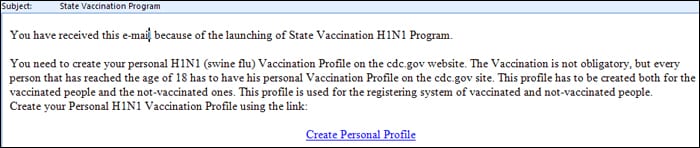
CDC has received reports of fraudulent emails (phishing) referencing a CDC sponsored State Vaccination Program.

The messages request that users must create a personal H1N1 (swine flu) Vaccination Profile on the cdc.gov website. The message then states that anyone that has reached the age of 18 has to have his/her personal Vaccination Profile on the cdc.gov site.

The CDC has NOT implemented a state vaccination program requiring registration on www.cdc.gov. Users that click on the email are at risk of having malicious code installed on their system. CDC reminds users to take the following steps to reduce the risk of being a victim of a phishing attack:

  • Do not follow unsolicited links and do not open or respond to unsolicited email messages.
  • Use caution when visiting untrusted websites.
  • Use caution when entering personal information online.

An example of the Phishing email follows:

Sample H1N1 phishing e-mail

CDC Experts Contributing to WebMD's Focus on Flu Blog

Follow CDC Experts on WebMDs Flu Blog – Visit NowIn collaboration with WebMD, experts from the Centers for Disease Control and Prevention are guest blogging and helping to answer questions on WebMD's Focus on Flu Blog. Check out the recent CDC blog post by Anthony Fiore, MD, MPH, medical epidemiologist with the CDC's Influenza Division: "Do People 65 and Older Need the H1N1 Vaccine?" The Focus on Flu blog is scheduled to run through the end of December.

Recent Updates of Interest

Additional Updates on the CDC H1N1 Flu Website

To learn about other recent updates made to the CDC H1N1 Flu Website, please check the "What's New" page on the CDC H1N1 Flu website.


Get H1N1 Updates & Health Tips via Text Message

For CDC Info, Text 'Health' to 87000. www.flu.govSign up to get health updates sent via text message. Messages are sent about three times a week with relevant H1N1 flu updates and timely health tips.

Text UPDATES to 87000 to sign up.

To learn more, see www.cdc.gov/mobile.


Modify/Update Subscriber Preferences  |  Unsubscribe  |  Send Feedback  |  Learn more about CDC Email Updates
 
To receive the latest news for your region, please update your profile with your country, state and zip code.
 
Questions or problems?  Please contact support@govdelivery.com.

Department of Health and Human Services

Fight Flu with Facts! • Visit Flu.gov
Call 800-232-4636 • Text UPDATES to 87000

Centers for Disease Control and Prevention

Centers for Disease Control and Prevention (CDC) · 1600 Clifton Rd · Atlanta GA 30333 · 800-CDC-INFO (800-232-4636)